


Table of Contents
- Enhancing Waste Management
- Reducing Environmental Impact
- Improving Urban Livability
- Technological Advancements
- Global Adoption
- Future Prospects
Modern cities are grappling with escalating challenges in maintaining cleanliness and efficiency as urban populations continue to grow. Innovations such as advanced vacuum systems are emerging as powerful tools to address these issues, thereby elevating the standards for urban environments. By transforming the way cities manage resources and waste, these systems directly contribute to healthier, more organized communities. An increasing number of municipalities are investing in advanced infrastructure solutions, such as hydro excavation vacuum technologies, to reduce inefficiencies and support sustainable development. These advancements not only facilitate streamlined installation and maintenance of underground utilities but also help modernize essential municipal services.
Advanced vacuum systems are integral to the next generation of smart city infrastructure. Their adoption is not limited to waste management—vacuum-based technology is crucial to optimizing resource distribution, minimizing environmental damage, and delivering improved quality of life to city residents. Embracing innovation, cities worldwide are deploying vacuum systems for tasks ranging from refuse collection to dewatering construction sites, illustrating the versatility and effectiveness of this technology.
Enhancing Waste Management
Traditional municipal waste collection often relies on fleets of trucks navigating crowded urban streets, which can lead to issues such as traffic congestion, increased carbon emissions, and safety risks for workers. Advanced vacuum waste systems, specifically pneumatic refuse collection networks, disrupt these outdated methods by channeling waste directly from disposal points through underground pipes to centralized collection centers. This closed, automated environment drastically reduces the need for visible curbside waste and waste-collection vehicles, while also decreasing the manual labor involved and exposure to potentially hazardous refuse. Cities benefit from cleaner streets and smoother logistical operations, while residents enjoy a tidier and more aesthetically pleasing environment.
Moreover, these systems pave the way for more strategic waste management. By separating refuse at the source and moving it directly to processing zones, vacuum systems create opportunities for recycling and composting initiatives to flourish. Automated sorting at the collection point is also possible, pushing cities closer to their waste diversion and sustainability goals. The effectiveness of pneumatic waste collection is evident in successful projects across urban centers, such as Barcelona and Seoul, where municipal costs and pollution levels have decreased notably since implementation.
Reducing Environmental Impact
One of the most compelling arguments for integrating vacuum systems into urban infrastructure is the environmental benefit. Conventional waste management relies heavily on gasoline- or diesel-powered collection vehicles, which significantly contribute to local air pollution and greenhouse gas emissions. In contrast, vacuum networks significantly reduce truck traffic in cities, resulting in lower particulate matter and CO₂ emissions. These direct benefits are evident in cities like Stockholm, where underground refuse systems have reduced the carbon footprint of municipal waste handling.
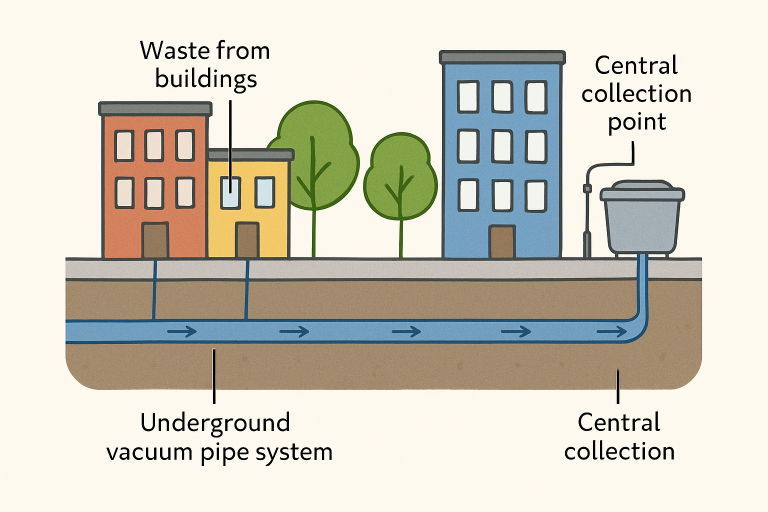
Additionally, vacuum systems encourage environmentally conscious behaviors among residents. Providing easily accessible disposal chutes that support the separation of recyclables, organics, and general waste, these networks promote source separation and higher recycling rates. This implementation not only supports urban environmental goals but also aligns with broader efforts to combat climate change outlined by global agencies and environmental organizations.
Improving Urban Livability
The impact of vacuum systems extends beyond operational improvements and sustainability—they are a catalyst for enhanced urban livability. Case studies from cities like Bergen, Norway, illustrate how switching to pneumatic waste collection has improved the appearance of historic districts, reduced noise pollution from early morning garbage trucks, and significantly decreased pest-related health concerns. As a result, both residents and businesses can enjoy cleaner public spaces, which has a positive impact on tourism and overall community morale.
Additional Benefits to Community Health
By moving refuse collection underground, exposure to contaminants and unsanitary environments is greatly diminished. Fewer overflowing bins and less open waste contribute to lower rates of allergens, airborne irritants, and disease vectors. The seamless and hygienic process enabled by vacuum systems makes for a notable improvement in urban health metrics and public satisfaction.
Technological Advancements
Recent advancements include integration with smart sensors, Internet of Things (IoT) devices, and artificial intelligence. These upgrades allow real-time monitoring of bin fill levels, providing city officials with precise data for scheduling collections and maintaining system efficiency. Predictive maintenance enabled by AI minimizes downtime and ensures system longevity, driving down long-term operational costs. Some cities have adopted these data-driven systems to synchronize vacuum collection with other municipal services, further optimizing public resource management.
Global Adoption
Vacuum waste management is no longer confined to select pilot programs. Forward-thinking cities, including Stockholm, Mecca, and Guangzhou, have fully deployed large-scale vacuum systems to handle diverse urban needs. In Mecca, the intricate pneumatic network processes up to 600 tons of waste daily, particularly during peak demand periods such as Ramadan and Hajj. These successes are motivating other major metropolitan regions to follow suit, introducing vacuum-based models that can be scaled for festivals, busy tourist seasons, or rapidly growing neighborhoods.
Future Prospects
As the demand for efficient, climate-friendly cities rises, ongoing research continues to push the capabilities of advanced vacuum systems. Future iterations are expected to deliver even greater automation, smarter self-diagnostics, and integrated solutions that complement other smart city elements such as energy grids and water management. The trajectory points to a future where vacuum systems serve as a backbone for sustainable and resilient municipal infrastructure worldwide.
Advanced vacuum systems are setting new benchmarks for urban cleanliness, efficiency, and sustainability. With growing evidence of their benefits in pioneering cities, they are bound to become foundational to modern urban infrastructure.